

Somewhere around month four of a D2C launch, a manufacturer's leadership team tends to have the same meeting. The product is arguably the best in its class. The packaging was done by a designer the team actually likes. The webshop is live and clean. The launch went out on time and on brief. And yet, they are here to work out why sales have never really taken off, why the marketplace listings keep getting flagged, and where the queue of unanswered consumer complaints is actually meant to go. Whoever is chairing asks who owns each of them. The answer, after a pause, is that nobody does yet. Each of them was always going to happen. Nobody had an accountable name attached to any of them in advance.
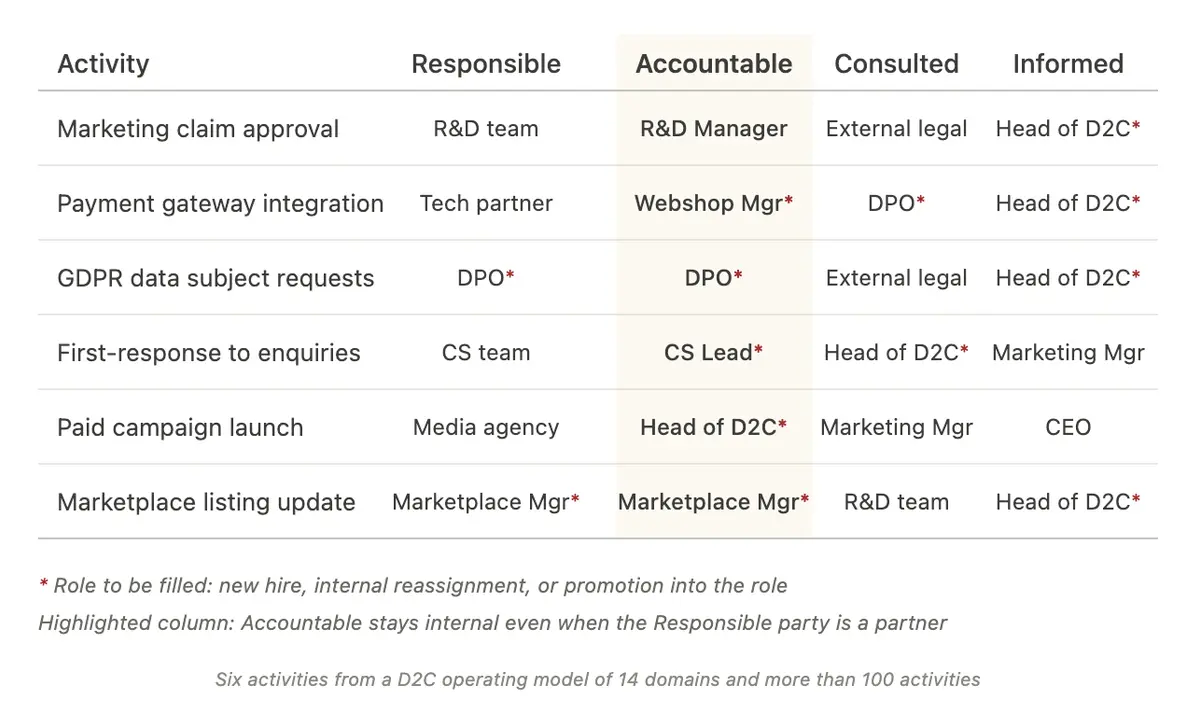
This is the moment the operating model asserts itself. Beneath every D2C launch is an operating model that either has a named owner behind each activity or does not. A RACI matrix is the least glamorous way to make that visible, and by some distance the most useful. At its core, RACI is a responsibility assignment matrix that breaks down every single task into four distinct roles: who executes the work (Responsible), who signs off on it (Accountable), who provides expertise (Consulted), and who needs to stay in the loop (Informed). It maps names directly to functions, stripping away ambiguity before the launch goes live.
What the operating model actually contains
A D2C operating model for an established manufacturer covers roughly fourteen distinct domains and more than a hundred discrete activities. Strategy and governance. Regulatory content approval. Product and catalogue data. Owned storefront operations. Platform and integrations. Brand marketing. Performance marketing. CRM, lifecycle and retention. Customer service and returns. Fulfilment and logistics. Marketplace operations. Data and analytics. Compliance and data protection. Finance and unit economics.
Each of those domains contains between three and twelve specific activities, and each activity needs a named owner. Not a job title in the abstract, an actual named person who is accountable for the outcome. Marketing claim approval before publication. Return windows and refund thresholds. GDPR data subject requests. Marketplace and webshop settlement reconciliation against the ERP. First-response protocols and service level agreements for customer enquiries. Lifecycle flows for welcome, post-purchase, replenishment and winback. Product portfolio productivity (top sellers reviews) and SKU rationalisation, the ongoing question of which variants stay in the range and which quietly earn their exit. Ultimate accountability does not belong to the platform partner or the fulfilment provider or the paid media agency, even when those partners do the work.
The exercise of mapping every one of those activities against a named owner, and honestly marking the cells where no owner exists today, leads to open operational conversation within leadership teams. Run it either as an internal exercise during an offsite day, or as a facilitated workshop with an outside partner where a third party makes candid naming easier. Either path works. Skipping the exercise altogether means letting the gaps surface later, one angry consumer email at a time. Few things are more corrosive to a manufacturer than the operational disruption that follows. In Eliyahu Goldratt's Critical Chain, the discipline is called Full Kit: no work should begin until every prerequisite is in place, because starting without one is where bad multitasking, rework, and cascading delays come from. A D2C launch is no different, and a launch without a full kit of named owners will find the gaps in real time.
Where manufacturers routinely find they are staffed
Established companies in the B2B manufacturing space already own more of the operating model than they realise. Regulatory compliance is usually well developed, sometimes to a standard well above what a direct consumer channel legally requires. Product and catalogue data are well defined, even if not in the right system. Quality assurance processes exist and are documented for audit to some extent. Production planning, inventory management, and existing distribution logistics all have documented owners. The R&D function is usually strong, especially in categories with a scientific or technical proposition. Finance operates. A sales team, most of the time, is fluent in the B2B customer relationship the business has always had.
That covers roughly a third of the RACI, filled in on the first part of a workshop or a working session.
Where the roles don't yet exist
There is equally a common part of the operating model less well-serviced. Across projects with companies preparing for D2C, the same pattern recurs: the consumer-facing part of the operating model rests almost entirely on roles that do not yet exist inside the business. In a recent engagement with a European manufacturer, that pattern surfaced as eight of the fourteen domains resting on six areas of responsibility that had never been staffed for a consumer channel. Head of D2C. Webshop manager. Marketplace manager. CRM and lifecycle manager. Customer service and returns lead. Data protection officer.
Every one of those roles was marked in the RACI as proposed. That means the accountability had been assigned to a role definition that still needed to be written, agreed, and filled. Filling it could mean a new hire, an internal reassignment of someone already inside the business who could carry the responsibility, or a promotion into the role. What matters operationally is that the accountable name against each activity is real and stable, regardless of which door the person came from.
The Head of D2C is usually the most consequential of the six areas. A D2C business without a named commercial owner produces exactly what the term suggests: a distributed effort that nobody has the authority to steer and nobody is accountable for. Every downstream role, and most of the partner briefs, wait on that appointment. In the manufacturer's case, the absence of a Head of D2C was the single largest organisational risk the initial discovery report flagged, ahead of any technical or regulatory concern.
The Customer Service and Returns Lead is the counterpart to that role. Where the Head of D2C owns the commercial trajectory, this role owns the operational reality every consumer experiences directly, and speaks for the consumer inside the room when trade-offs get made. Response time on a complaint. Tone on a refund conversation. A return arriving at the warehouse in the right condition and being logged correctly. In a B2B business, these interactions are absorbed by an account manager who already has the customer's context and a working relationship. In D2C, every one of them is a first encounter, and every one of them scales unforgivingly. A weak customer service and returns operation in the early months of a launch produces a review pattern that follows the brand for years.
These two areas of responsibility are the pair a consumer-facing business cannot compress into one. The instinct at launch is to appoint one Head of D2C who also owns customer service, on the logic that volume is small and a single senior owner can span both. The result, consistently, is that one of the two gets under-served. A Head of D2C hired for commercial fluency optimises for acquisition and lets the service backlog grow. One hired from an operations background runs a tight service ship and stalls the commercial trajectory. The two competencies are different in kind, and the two accountabilities do not share one calendar without one of them going missing.
The remaining roles matter for different reasons. A data protection officer only becomes essential the day the business starts handling consumer data directly, which is also the day the business becomes exposed under GDPR to obligations it has never had to service. A CRM and lifecycle manager is who decides whether the first thousand customers are ever contacted again after the first purchase, which is where the D2C unit economics actually live. A webshop manager and a marketplace manager can, in principle, be one person for the first few months, though the skill sets diverge quickly once volume moves above launch levels.
The accountability that does not outsource
A common instinct at this point is to outsource large sections of the operating model. Technical delivery to a specialist partner. Fulfilment to a third-party logistics provider. Paid media and marketplace listings to an agency. Regulatory review to a consultant. Each of those is often the right call for the R in RACI, the party that does the work.
None of them removes the need for an accountable owner inside the business. The A in RACI is the single person who signs off, holds the partner brief accountable, resolves conflicts across partners, and makes the operational decisions that partners are neither positioned nor equipped to make. Only an internal named owner can carry that role, because only an internal named owner is inside the manufacturer's commercial and regulatory perimeter. The business that appoints partners without appointing owners ends up with a set of silos that nobody can integrate.
The exercise of separating R from A across the full RACI is where the in-house-or-partner question moves from a slide to a concrete Year 1 operational plan. Who owns what internally. Which activities are contracted out to partners. Which existing team members carry additional accountability. Where a new hire is genuinely required. It is a difficult conversation, because it exposes both the true internal capacity required and the true external partner cost at the same time. It is also the conversation that determines whether the D2C business is operationally planned or is still aspirational.
The RACI as an honest test
A completed RACI has one property that most strategic documents do not. It is falsifiable. Every activity either has an accountable owner or does not. Every proposed role either has a filling decision behind it, whether new hire, internal reassignment, or partner escalation, or does not. A leadership team can look at a completed RACI and quickly see whether the D2C business they have described in the slide deck is one they have operationally staffed for.
The manufacturers who launch D2C well are the ones who go through this exercise before they select a platform, and treat the gaps it exposes as the highest-priority items in the Year 1 operational roadmap. The ones who struggle are the ones who arrive at the same conversation three or six months later, once the technical build is already in flight and owners are being named reactively to catch problems that have already surfaced on the consumer side.
A D2C launch is an operations plan wearing a marketing narrative. The RACI is the operations plan underneath.
The operating model rarely earns space in a board deck. It is, however, the artefact that determines whether the launch holds together six months in, and it is often the fastest way to tell whether a manufacturer is genuinely ready for the channel or is naming it because the market has already named it. Every serious D2C plan has a set of named owners hidden inside it. The RACI is what makes those owners visible, and who each of them actually is.