

🎧 Listen to the full episode here.
It’s Saturday morning, and instead of enjoying your weekend, you discover that your online store stopped sending orders to your warehouse management system 3 days ago. No error message was thrown, only a silent and costly breakdown in a hidden piece of custom code.
In e-commerce, integrations between your online shop and external systems, like your ERP, CRM, or WMS, have historically been a giant black box. When they work, they’re invisible. When a platform update rolls out and they break, it turns into a crisis.
During a recent episode of The Open Podcast, Sander Mangel sat down with Shopware’s Samuel Crudge Hill, Product Manager for the Shopware Nexus project, at the Shopware Community Day in Cologne.
They discussed why data routing is shifting from a background development task to a central business priority, and how Shopware’s new tool, Nexus, aims to hand control back to merchants.
The problem with "brittle" connections
Traditionally, connecting your online store to an external system meant hiring a development partner to build a custom integration which can create long-term operational risk.
E-commerce platforms, as well as the software they integrate with, evolve constantly. When your core shop software updates, those custom, third-party connections often become fragile. If an API (the bridge that lets two programs talk to each other) changes even slightly, the connection snaps.
"The problems we're seeing brought to us is that these integrations become brittle," Sam explained during the episode. "They needed a more stable solution... lowering the risk profile when it comes to managing your shop."
For years, businesses looked to standalone iPaaS (Integration Platform as a Service) systems to solve this. But introducing yet another third-party software vendor into your technology stack adds cost, complexity, and another contract to manage. In many cases that is warranted, building a custom integration is infinitely more complex and costly. However, for webshops with a few connections, it's less so.
What is Shopware Nexus
Nexus is Shopware’s native answer to this dilemma. Instead of treating data routing as an afterthought or outsourcing it to an external platform, Nexus, as Samuel puts it, is “built right alongside the core software.”
To understand where it fits, it helps to look at how it compares to tools you might already know:
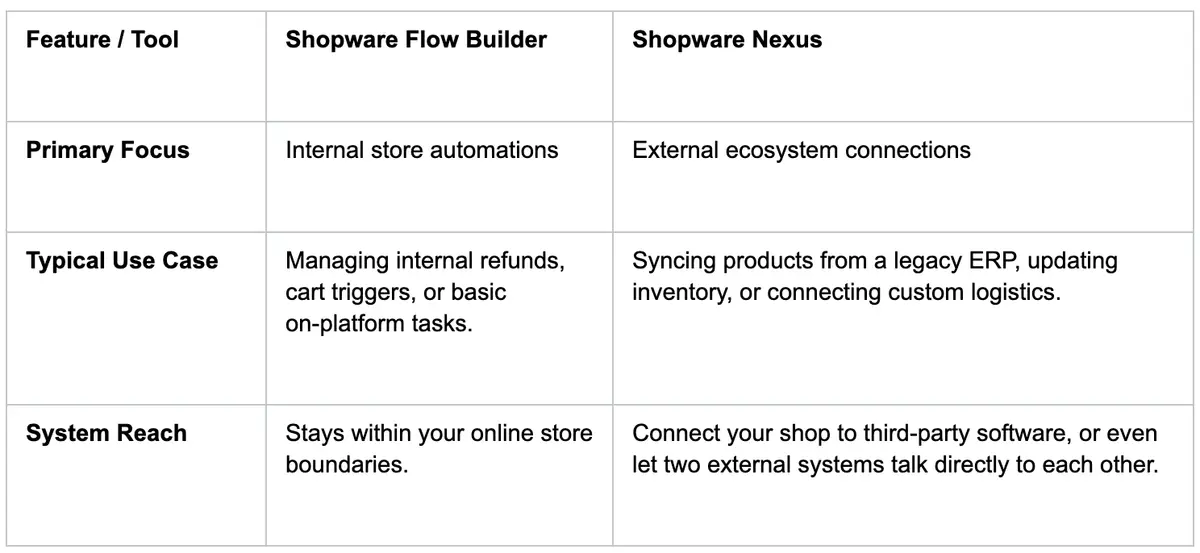
Think of Nexus as a central data highway (a "data bus"). If you are running an older inventory management system and want to migrate to a modern one, Nexus acts as the traffic controller, safely moving information from point A to point B without breaking the customer-facing store.
Where Nexus really delivers
One of the most frustrating aspects of standard data integrations is trying to find out why something failed. Often, the cause is not simply in the API field mapping. It’s a side effect of a 3rd party application, a change in a database schema field setting, or a character limit that went unnoticed.
Finding that single over-limit field used to require hours of tedious digging. Nexus removes the mystery through deep data lineage and execution history. It allows non-technical team members to look directly inside the pipeline.
You can visually track a data transmission step-by-step:
- The schedule triggered successfully.
- Data was pulled from the shop successfully.
- The data was sent to the warehouse system: Failed.
Because you can see the exact package of data (the payload) that caused the stutter, pinpointing the issue takes seconds instead of days.
How AI is changing the interface
There is a paradigm shift in how we interact today with software. Traditional admin dashboards are beginning to take a backseat. Instead of clicking through 20 menus in a CRM or an e-commerce backend, team members are increasingly using AI layers, like Claude or ChatGPT, to query data and make changes using natural, everyday language.
Nexus is actively positioning itself for this shift. By integrating AI features and Model Context Protocol (MCP) capabilities, the goal is to entirely flatten the learning curve for developers and non-developers alike.
Imagine wanting to add a new custom field to your shipping documents. Instead of writing a development brief, you'll eventually be able to simply instruct the system in plain English:
"I want our warehouse data to include this specific customer note field, formatted exactly like this, coming from our CRM. Please update the workflow."
By passing clean, contextual data through a native layer, the system can leverage AI to handle the heavy technical lifting and self-diagnose errors on the fly.
Data belongs to the merchant
As Sander shares during the episode, “data is becoming a first-class citizen in e-commerce and tools like Nexus are the proof.”
It shifts integrations away from a high-risk technical burden that is managed exclusively by developers and instead, turns data flows into an open asset that business teams can confidently own and control.