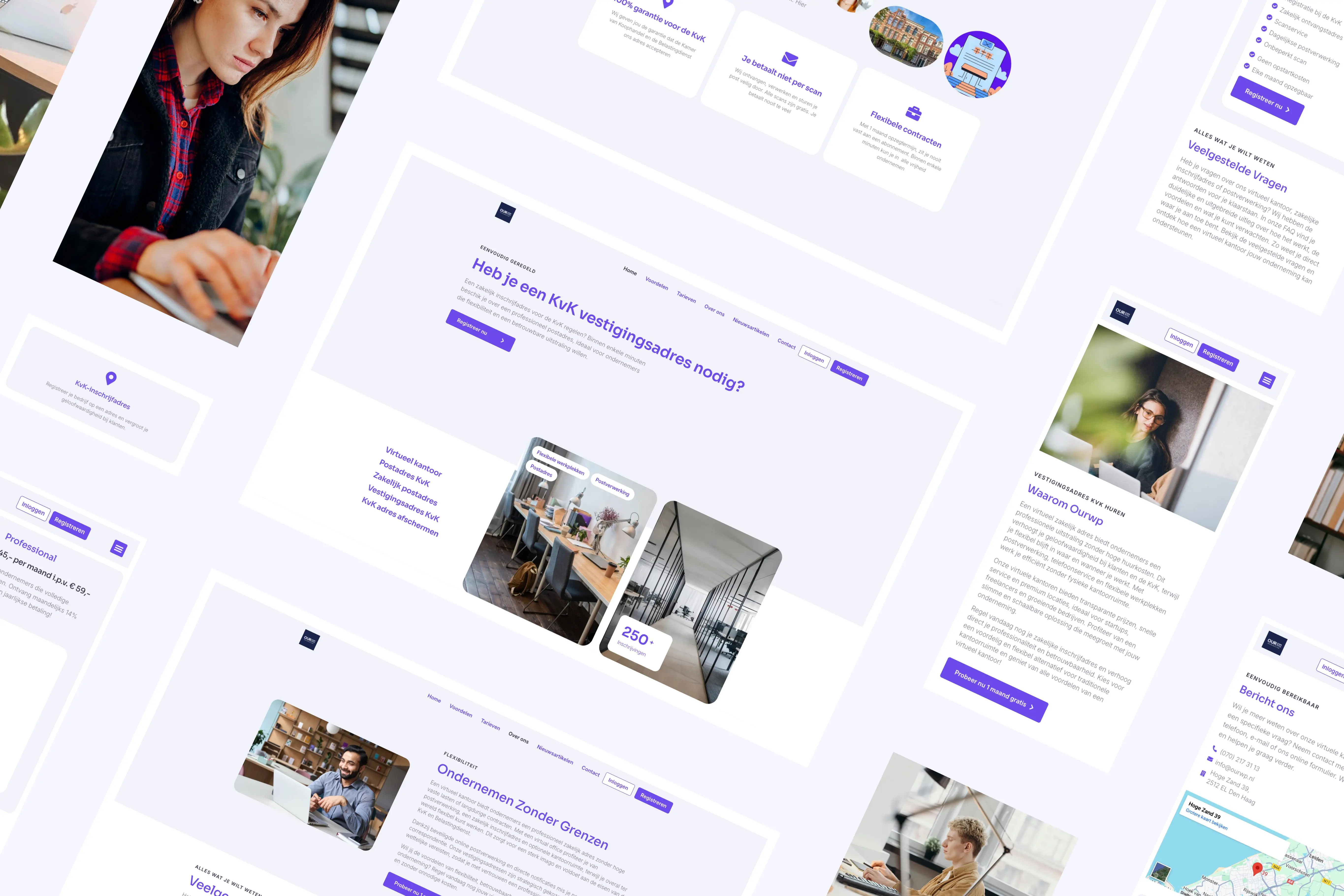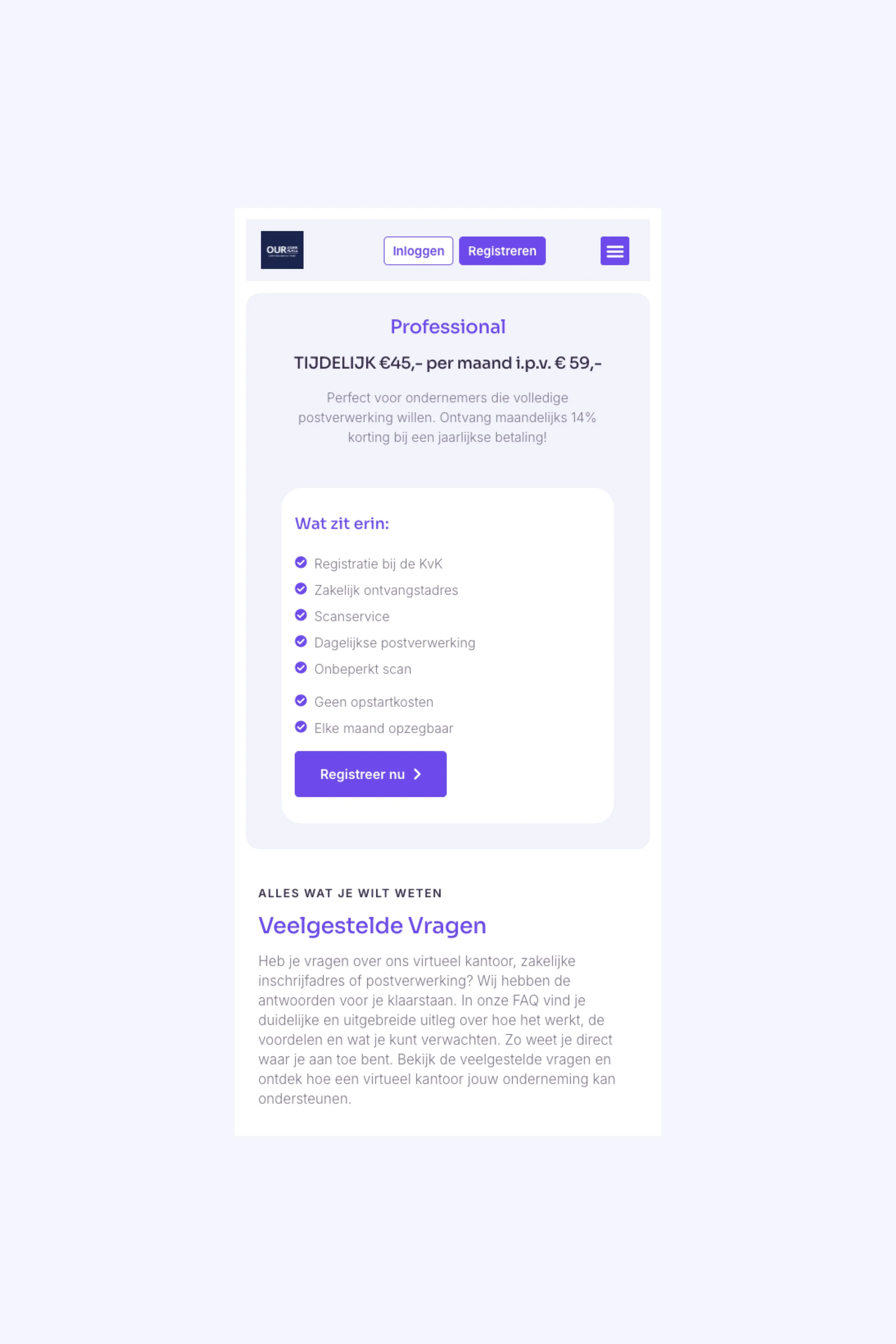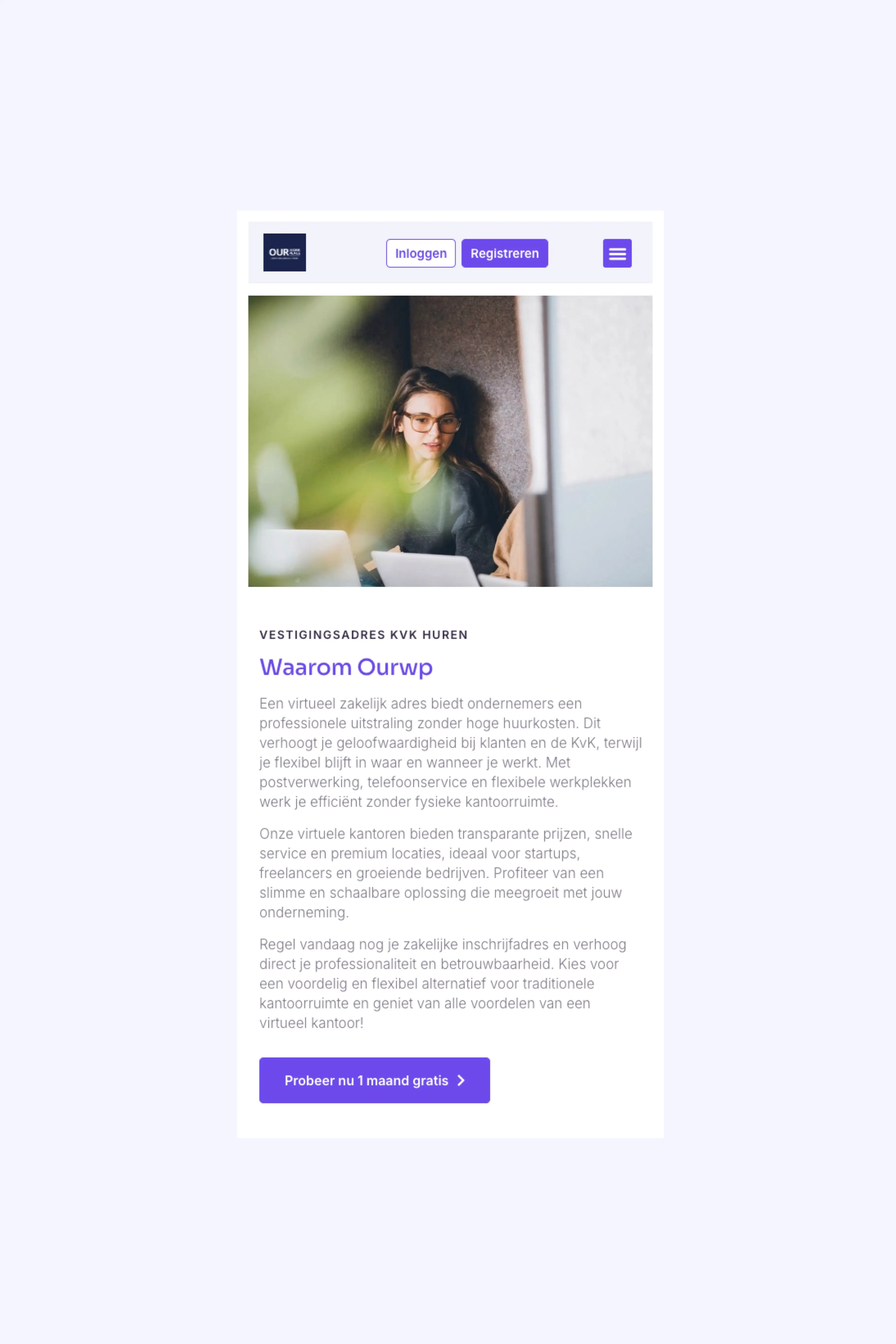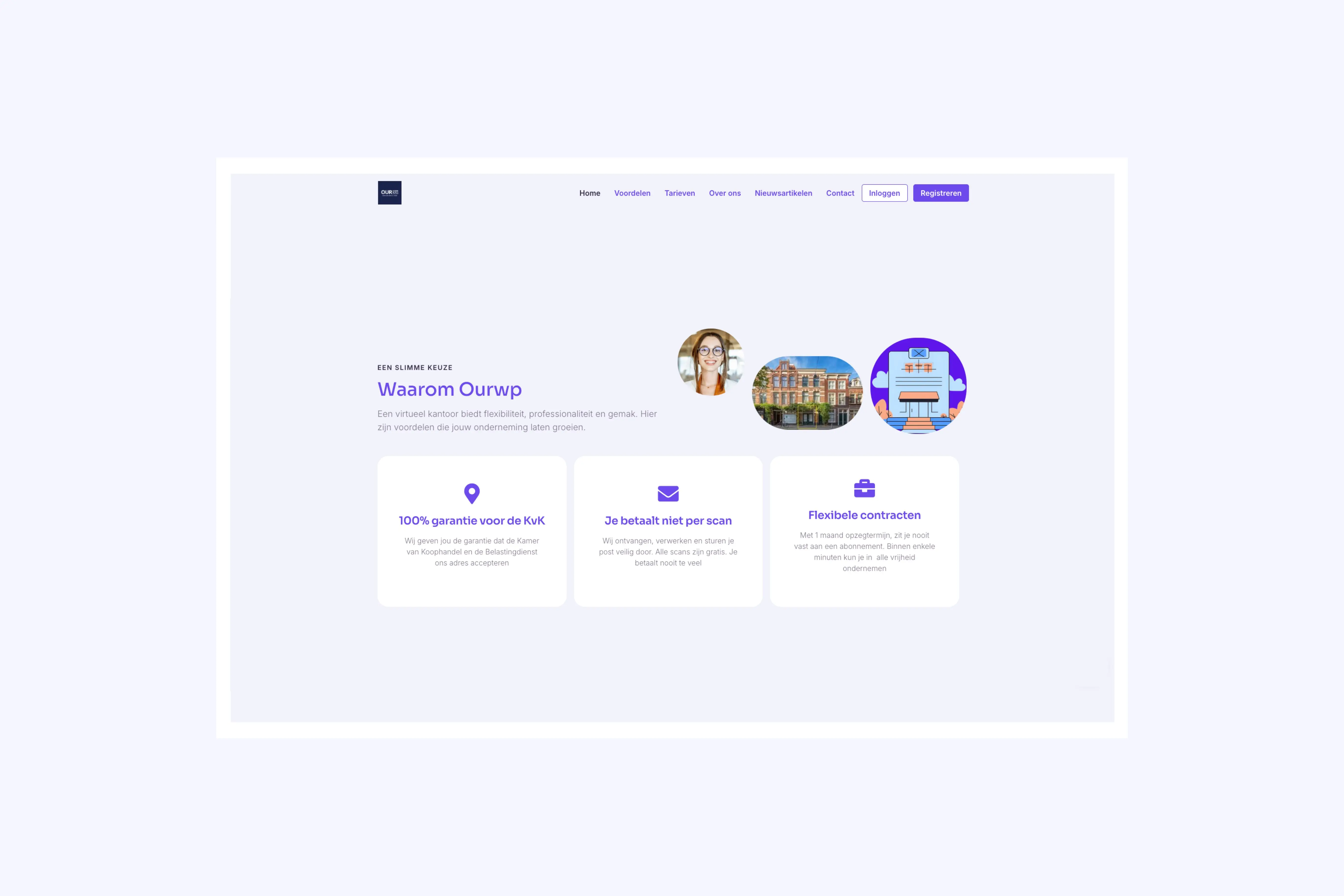
Our Workplace transforms compliance into a scalable competitive advantage
Open Commerce helped design a fully automated onboarding process that combines compliance with user-friendliness. By creating distinct registration flows for different customer types — individuals, freelancers, and limited liability companies — only relevant information is requested. For complex entities like LLCs, all required checks were completed, including Ultimate Beneficial Owner (UBO) verification, without creating administrative chaos.
Technically, we integrated multiple specialized services into a modular system: Stripe Identity for document verification, KVK integration for real-time company data, Xodo Sign for legally binding signatures, and Postcode.eu for address validation. The result is a seamless, scalable platform that meets the strictest regulations while remaining flexible for future expansion.
Thanks to this approach, Our Workplace can now process applications 24/7, ensure full AML compliance, and scale marketing efforts without operational constraints. The platform provides instant feedback to applicants and automatically generates audit trails, making compliance both efficient and customer-friendly.
Automating AML compliance onboarding for OurWorkPlace
A Dutch virtual address provider was verifying every new customer by hand. We mapped the onboarding step by step, then rebuilt it end-to-end in three months.
The check behind every new customer
Every application to OurWorkPlace has to be checked before the customer can use one of its addresses, and for years that check ran on the time of its owner, Karim. He went through each submission himself and decided, from scanned identity documents, whether the applicant was who they claimed to be and whether the documents had been altered.
Documents are only part of the check. It also takes specific questions put to the applicant and a bank transaction that confirms the name, so an off-the-shelf verification product would not have covered it. What OurWorkPlace needed was the whole sequence running as one process, and that was the part we were there to build.
OurWorkPlace rents business addresses to entrepreneurs who would rather register with the Dutch Chamber of Commerce at one of its locations in Den Haag, Rotterdam or Rijswijk than publish their home address, and it guarantees that the KvK and the Belastingdienst, the Dutch tax authority, will accept it. That guarantee is the product, and it puts the company under the Wwft, the Dutch anti-money-laundering law.
"They get inspected every year, and weak checks mean OurWorkPlace is shut down."
Sander Mangel, solutions architect, Open Commerce
The economics pointed the same way: at the time of the project, a business address started at 39 euros a month, which left little room for hours of senior attention at the start of every customer relationship. The site promises registration in minutes while the regulation demands thorough verification, and something had to reconcile the two.
Working out what was actually needed
OurWorkPlace had no developers of its own, so the platform it was running had been built by an outside supplier and had been live for years by the time we arrived.
Our first job was to understand what was already there rather than to propose replacing it. A review of the code and the architecture confirmed that the platform could support the new onboarding, so the client was never asked to move to a new one. We came in, stabilised what was there, and built on top of it.
Part of that work was compliance. An onboarding platform holds identity documents, so we reworked how those files were handled so that a document could only be reached by the people entitled to see it, a rule we went on to test role by role, and we advised moving to sturdier hosting. That work came before any conversation about new functionality.
"A rewrite is the easiest thing to recommend and the most expensive thing to get wrong. This client had been paying for the platform for years. Our job was to work out which parts still earned their place, and build around those."
Vlad, developer on the project, Open Commerce
With the platform stable, we ran a series of workshops at the client's own offices, starting in November 2024, working through the onboarding as the customer experienced it at the time. The target we set there was an onboarding that runs to completion without an administrator having to touch it.
"We mapped the customer journey after the initial form: every step, every variation, every decision point. Once the plan was there, we could build it basically in one shot."
Sander Mangel, solutions architect, Open Commerce
The map itself became the thing the client signed off. He went through it step by step and approved each one, chose between the options we put in front of him, and settled details like the naming of the locations before any of it was built.
"Together with Sander, I walked through every step of the process. That's when I realized how many of those steps could actually be automated. At the same time, it gave me a much clearer insight into my own workflows, which, as an entrepreneur, was incredibly valuable."
Karim, owner, OurWorkPlace
We then turned that map into clickable prototypes, so the owner could work through the new onboarding himself and see how it would behave, rather than read a description or review a static mockup. We wrote the prototype code so it could be reused, and it became the foundation of the production build.
The same pattern held for every open question in the project.
"When something was unclear, we came back with two options rather than a question. The client either chose one or proposed a third. It kept decisions moving."
Maryna, project manager and QA engineer on the project, Open Commerce
What we built
One route per type of customer
An individual, a freelancer, and a BV, the Dutch limited company, each need different documents and different checks, so each entity type follows its own path and sees only the steps that apply to it. A sole proprietor has no beneficial owners to declare, and an entrepreneur who has just moved to the Netherlands may never have encountered the term UBO at all.
Where a company does have beneficial owners, each of them receives an invitation and completes their own verification, so a more complex business means several verifications rather than one.
Verification, signature, and payment inside the flow
Stripe handles subscriptions and identity verification, KvK confirms company registrations, Xodo Sign handles the contract, prefilled with what the customer has already entered, and Postcode.eu turns a postcode into a street and number in seconds. We used outside services only where they provided real value, rather than building a fully custom stack.
An architecture built for a moving target
The onboarding is modular by design, so regulatory change can be absorbed without reopening the system. That shows in daily use: the strictness of identity verification is configurable by the client, and when a new step is added, every account has to complete it, including customers who onboarded before it existed.
The whole thing was delivered in three months.
Where it stands now
The owner no longer inspects ID cards. Identity is verified by a system built for it, payment runs inside the flow, and each type of customer is asked only for what their situation requires. The routine checks no longer run on the owner's time, so the business can take on more customers without scaling the same manual workload.
"Thanks to the new automated workflow, I can focus far more on the actual substance of my work rather than wasting time gathering documents and information. The biggest takeaway for me: I simply have more time on my hands."
Karim, owner, OurWorkPlace
We are still working with OurWorkPlace, and alongside support and ongoing feature work we recently released the first version of an AI-powered document processor built on the platform's own data. Handling incoming documents automatically was on the list at that first workshop in 2024, once the onboarding was dealt with. Incoming post used to mean reading each item, working out who it belonged to, finding them on the dashboard and forwarding it. Now the system proposes the recipient and the owner reviews the suggestion.
The first automation removed the work that was capping growth. The second was possible because the platform and its data were in good enough shape to build on.
Facing the same problem? If your business depends on a process that only works because someone experienced is doing it by hand, that is worth mapping before anyone proposes software. Book a conversation with us.