Your team knows the gear, understands the conditions, and can explain why one product fits a customer’s plans better than another. In a store, that expertise becomes a conversation. Online, the customer often gets a list of specifications instead. Our free workbook helps you find out how much of that advice actually reaches your product pages.
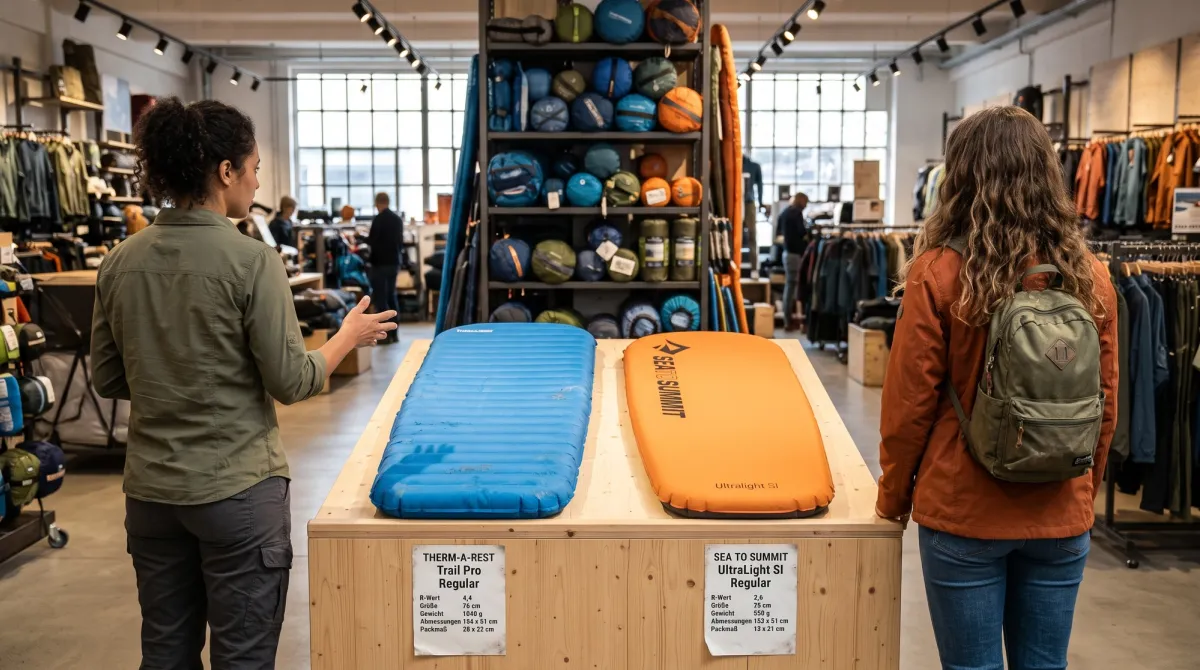
Ask any associate that knows their outdoor gear about a sleeping mat for an autumn trip and they won’t point you directly to the product with the highest R-value. They’ll ask where you’re going, whether you sleep cold and carry your gear, then explain what fits and why. Online, supplier data is thin and ranges change every season or two, so most of that reasoning never reaches the product page.
Let’s illustrate that with some example questions and the information we find on most product pages:
The customer asks | The expert explains | The product page says |
|---|---|---|
“Will this keep me warm in October?” | It depends on the night temperature, your sleeping bag and whether you sleep cold. Fine for most autumn nights; add insulation on frosty ones. | R-value: 3.2 |
“Why does it cost more than a self-inflating mat?” | It’s lighter and packs much smaller. Only worth it if you carry it yourself; by the car, the cheaper mat is more comfortable. | 480 g · Packed 23 × 10 cm |
“Will I fit on it?” | The Regular suits most people up to 1.83 m. With broad shoulders, consider the Wide version. | 183 × 51 × 7 cm |
“Will this keep me warm on my trip?” A specification is a fact. Customers need to know what it means for the conditions they expect and the gear they already own.
“What do I gain by paying more?” Weight, packed size, comfort, durability, ease of use. Explain which differences matter, and for whom.
“Is something else a better fit for me?” Good advice includes saying when a simpler or less expensive option does the job. Your pages can do the same.
Customers buy a product not for it’s own sake, they buy it because they need it to do a job for them. Convince them it’s the right choice for the job, and the customer will convert. We start with the qualifying questions your associate would ask on the store floor. Those show which conditions, facts and trade-offs shape a recommendation.
Then we look at the data behind your pages. For a retailer, that often means making supplier information consistent across brands. For a brand selling direct, it means turning specialist product knowledge into explanations customers can use.
The result is consistent buying guidance across a whole category, season after season. Your experts review the interpretation before anything goes live.

Outdoor retail, Netherlands
At Vrijbuiter, that meant aligning supplier data and organising the catalogue into category-specific attributes. A trousers pilot covered material, fit, activity, weight, and temperature range — the facts needed to explain which product suits which trip.
A free, practical workbook for a webshop manager and a colleague who gives advice every day: a store expert, product specialist or customer-service colleague. About 30 minutes per product, using your own products and your own customers’ questions.
1. Choose three products: one customers ask lots of questions about, one that’s hard to compare, and one that matters commercially.
2. Reconstruct the advice conversation: what the customer asks, what the expert asks back, and what changes the recommendation.
3. Compare it with your product page: score each buying question 0, 1 or 2, and see whether your content is in good shape or needs work.
4. Choose three improvements: what changes on the page, who supplies the knowledge, who updates the content and how you’ll check the result.
Includes worksheets for three products, a worked example and starting questions for sleeping gear, tents and trekking backpacks.
Interested in improving your product data? Bring a completed worksheet, or a product category where the same questions keep coming back. We’ll look at what your customers need to understand, where that information lives today, and how to turn it into consistent product content across the category.
