

Black Friday is 27 November, and the busiest stretch of the year comes with it. Adobe expects US shoppers alone to spend a record $275.1 billion online between 1 November and 31 December, up 6.7% on last year. Cyber Week, the five days from Thanksgiving to Cyber Monday, is forecast to bring in $47.5 billion of that.
When this much revenue lands in a few weeks, small problems get expensive. A product page that AI assistants can't read, a site that slows to a crawl at 9 a.m. on Black Friday, or a checkout with a surprise fee can each cost you a large share of your best sales days.
The good news is that you still have about three weeks. That's not enough time to rebuild your platform, but it is enough to fix the things that matter most. Here are three areas to focus on, in the order your customers experience them: how they find you, whether your site holds up, and whether they actually pay.
1. Customers are finding you differently
More and more shoppers start with an AI assistant instead of a search engine. They ask it to "find a warm winter jacket under €150" or "compare these three headphones", then click through to the store it recommends.
This shift is already showing up in sales data. During the 2025 holiday season, traffic from generative AI tools to US retail sites grew roughly 700% year on year, according to Adobe. These visitors also converted 31% more often than visitors from other sources. For 2026, Adobe expects AI-driven visits to retail sites to rise another 130%, with the biggest jumps on Thanksgiving and Black Friday.
AI shoppers arrive ready to buy, but only if the assistant can understand your products well enough to recommend them. Here is what you can do before Black Friday:
- Complete your product data. Fill in sizes, materials, compatibility, dimensions and use cases. AI tools can't recommend what they can't read.
- Keep prices and stock accurate. Being recommended for a product that turns out to be sold out or priced differently costs you trust and the sale.
- Add structured data to product pages. Product, price, availability and review markup (schema.org) help machines read your catalog correctly.
- Answer real questions on the page. Add short FAQs about shipping times, returns and sizing, since these are exactly what shoppers ask an assistant.
- Check that AI crawlers can reach your site. Some security settings and bot blockers turn away AI tools without anyone noticing.
2. Your site has to hold up
Even the biggest platforms struggle under holiday load. On Cyber Monday 2025, Shopify reported a "system degradation" that left some merchants unable to log in to their admin for hours, on one of the most important sales days of the year.
A full outage is the worst case, but a slow site quietly costs you money every day. A Deloitte study for Google found that making a mobile site just 0.1 seconds faster lifted retail conversions by 8.4% and raised order values by 9.2%. Speed matters even more this season, because Adobe expects mobile to account for a record 63% of online spend during Cyber Week.
Three weeks is enough time to lower your risk significantly:
- Load test now. Simulate two to three times your expected peak traffic, including searches, add-to-cart and checkout, not just the homepage. Fix the first thing that breaks, then test again.
- Check third parties. Payment providers, search, reviews, and tracking scripts can all slow down your pages or even bring them down. Remove any you don't need and make sure the ones you keep fail gracefully.
- Freeze risky changes. Set a code freeze from about a week before Black Friday until after Cyber Monday. Only urgent fixes should go live during that time.
- Prepare a plan for when things go wrong. Decide who is on call, who can make decisions, how you'll tell customers, and what you'll switch off first to keep checkout running.
- Monitor in real time. Track page speed, error rates and checkout success while the sale is live, with alerts that reach a person within minutes.
3. Don't lose them at checkout
Getting a shopper to the cart is hard work, yet about 70% of online carts are abandoned, according to Baymard Institute's average across 50 studies. Many of those shoppers were only browsing. But a large share leaves because of problems you can fix, and Baymard estimates that better checkout design alone could raise conversion rates for large online stores by 35%.
These are the most common fixable reasons US shoppers give for leaving during checkout, along with what you can still do before spending season:
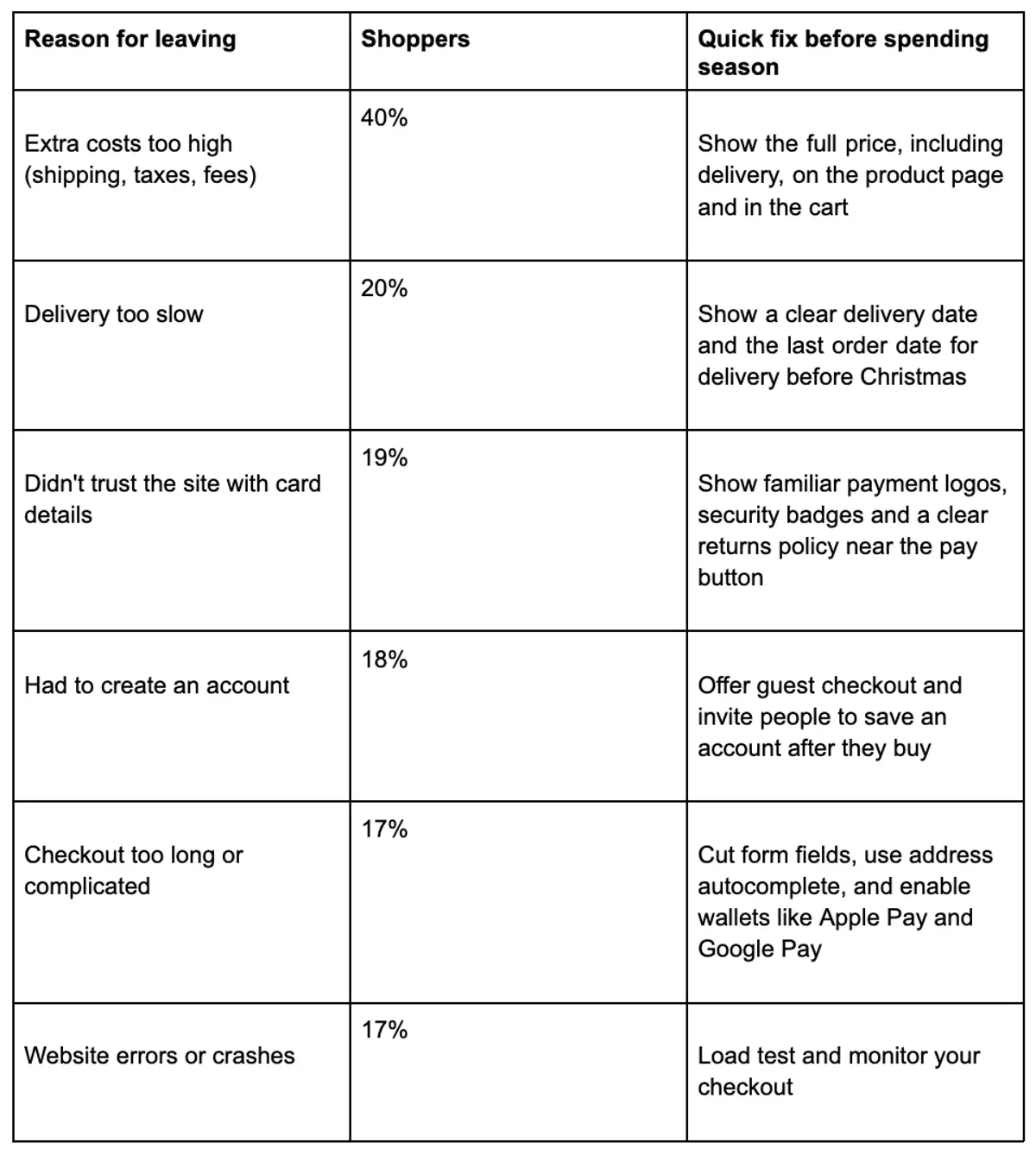
Source: Baymard Institute. Shoppers could give more than one reason.
Payment options matter too. Adobe expects US shoppers to spend $21.3 billion through Buy Now, Pay Later in November and December. If your customers use it, offering it at checkout can keep larger baskets from being abandoned.
Finally, walk through your checkout on your own phone before the sale starts. Mobile is where most holiday shoppers will pay, and it's where small annoyances add up fastest.
Your three-week checklist
- Fill gaps in product data and check that prices and stock are accurate everywhere
- Add or validate structured data on your top-selling product pages
- Confirm AI crawlers aren't blocked by your security settings
- Load test search, cart and checkout at two to three times your expected peak
- Review third-party scripts and remove the ones you don't need
- Set a code freeze from a week before Black Friday through Cyber Monday
- Write a short incident plan: who's on call, who decides, how you tell customers
- Show full costs and delivery dates before checkout
- Turn on guest checkout and digital wallets
- Complete a test purchase on a phone
Holiday sales are won or lost before most customers even click. Shoppers need to find you, your site needs to stay fast, and checkout needs to feel effortless. Each of these can still be improved before the spending season.
Sources
- Adobe: U.S. Holiday Shopping Season to Hit Record $275.1 Billion Online, September 2026
- Digital Commerce 360: Generative AI online holiday shopping traffic, 2025, January 2026
- Engadget: Shopify was down for much of Cyber Monday, December 2025
- web.dev: Milliseconds make millions (Deloitte and 55 for Google)
- Baymard Institute: Cart abandonment rate statistics